01 / System reliability
Why Availability Matters
Availability directly affects:
- Customer experience
- Service continuity
- Operational performance
- Revenue protection
- Regulatory compliance
- Business risk
Organizations often define service objectives using Service Level Agreements (SLAs) that specify minimum availability requirements.
Examples include:
- 99.0% Availability
- 99.9% Availability
- 99.99% Availability
- 99.999% Availability
Small improvements in availability can significantly reduce operational downtime.
02 / System reliability
Reliability versus Availability
A highly reliable system may still experience poor availability if repairs take a long time.
Conversely, a system with moderate reliability may achieve high availability if failures can be repaired quickly.
Availability therefore depends upon both:
Availability is commonly represented as:
where:
- A = Availability
- MTTF = Mean Time To Failure
- MTTR = Mean Time To Repair
This relationship illustrates that both failure behavior and repair efficiency contribute to overall service continuity.
03 / System reliability
Availability within FUSION
FUSION integrates:
This integrated perspective enables system-level availability estimation using both software and hardware information.
Unlike traditional approaches that focus primarily on hardware, FUSION incorporates software operational reliability into availability calculations.
04 / System reliability
Integrated Availability Modeling
The FUSION framework uses integrated software and hardware reliability information to estimate operational availability.
Software contributes through:
- Operational failures
- Recovery mechanisms
- Restart behavior
- Defect correction activities
Hardware contributes through:
- Component failures
- Maintenance activities
- Replacement actions
- Redundancy mechanisms
Together, these factors determine the system's overall availability.
05 / System reliability
Intelligent Availability Analysis
FUSION provides availability analysis through the Intelligent Graphical Editor (iGRED).
Engineers can model software-intensive systems using Reliability Block Diagrams (RBDs) and automatically calculate availability metrics for alternative architectures.
Supported configurations include:
- Single-node systems
- Series systems
- Parallel systems
- Active-active redundancy
- Active-standby redundancy
- k-out-of-n architectures
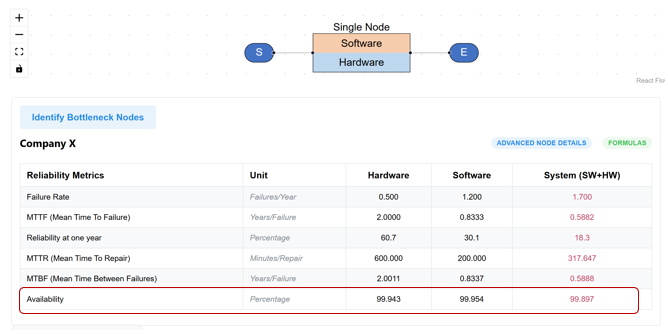
FUSION computes software, hardware, and system-level availability metrics for integrated software-hardware systems. The example shown achieves a system availability of 99.897%.
The ability to compute availability from integrated software and hardware reliability information provides engineers with early visibility into operational performance.
06 / System reliability
Availability Metrics
FUSION supports estimation of:
- Availability
- Downtime
- Failure Rate
- MTTF
- MTTR
- MTBF
These metrics are computed automatically for both individual components and complete systems.
Availability calculations are updated in real time as architectures and reliability parameters are modified.
07 / System reliability
Availability Targets and Service Levels
Availability objectives are often expressed as service-level targets.
| Availability | Approximate Downtime per Year |
|---|---|
| 99.0% | 3.65 days |
| 99.9% | 8.76 hours |
| 99.99% | 52.6 minutes |
| 99.999% | 5.26 minutes |
| 99.9999% | 31.5 seconds |
Availability modeling helps organizations determine whether proposed architectures can realistically achieve these objectives.
08 / System reliability
Availability Improvement Through Redundancy
One of the most effective methods for improving availability is redundancy.
Common redundancy strategies include:
- Parallel architectures
- Active-active configurations
- Active-standby configurations
- k-out-of-n systems
Redundancy reduces service interruptions by eliminating single points of failure and providing alternative operational paths when failures occur.
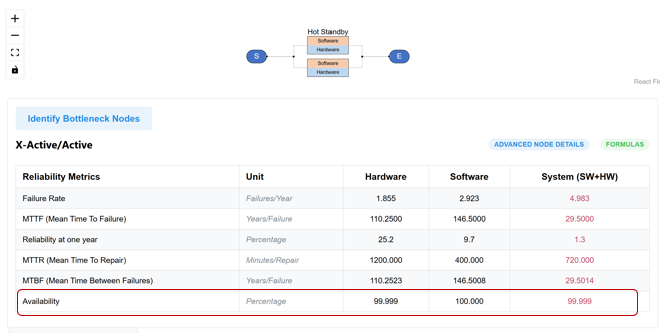
Availability modeling enables evaluation of alternative architectures before deployment. In this example, a hot-standby configuration improves system availability from 99.897% to 99.999%. Although the numerical difference appears small, the resulting reduction in annual downtime can be substantial for mission-critical systems.
The examples shown in Figures 1 and 2 illustrate how architecture decisions directly affect operational availability.
| Architecture | Availability |
|---|---|
| Single Unit System | 99.897% |
| Hot-Standby System | 99.999% |
Although both architectures use similar software and hardware components, the addition of redundancy significantly reduces service interruptions and improves operational resilience.
Availability modeling enables engineers to quantify these improvements before systems are deployed.
09 / System reliability
Reliability Bottlenecks and Availability
A small number of critical components often constrain availability.
FUSION automatically identifies:
- Availability bottlenecks
- Reliability bottlenecks
- Critical software components
- Critical hardware components
This capability helps organizations focus improvement efforts where they will have the greatest impact.
By identifying bottlenecks early, engineers can improve availability more efficiently and reduce operational risk.
10 / System reliability
Supporting Modern Software-Intensive Systems
Availability Modeling is particularly valuable for:
- Open RAN networks
- Cloud-native platforms
- Aerospace systems
- Medical systems
- Industrial automation systems
- Semiconductor manufacturing systems
- Autonomous transportation systems
These environments require high levels of service continuity and operational resilience.
11 / System reliability
From Metrics to Operational Decisions
Availability modeling supports decisions regarding:
- Architecture selection
- Redundancy investment
- Maintenance planning
- Resource allocation
- Service-level commitments
The result is a proactive approach to operational risk management that helps organizations improve reliability and service continuity.
12 / System reliability
Beyond Traditional Availability Analysis
Traditional availability analysis often focuses exclusively on hardware behavior.
FUSION extends this perspective by integrating:
This unified approach provides a more realistic representation of modern software-intensive systems.
13 / System reliability
Looking Ahead
Availability Modeling transforms integrated reliability information into operational performance predictions.
The next Methods page introduces Reliability Block Diagrams (RBDs), which provide the architectural foundation for modeling complex software-hardware systems and evaluating reliability and availability across alternative configurations.
Together, these capabilities form the foundation of the FUSION™ framework for integrated reliability engineering.