
Awarded by the NSF (National Science Foundation) for innovative system reliability research.
Why Traditional Reliability Falls Short
Modern, software-driven systems introduce complex reliability risks. In tightly integrated environments, a single defect—software or hardware—can cascade into system-wide failure. Traditional reliability models leave critical gaps once systems move into operation.
Built for Mission-Critical Teams
Designed for systems engineers, reliability experts, and integrators who need early, actionable insight into system reliability.
Optimize System Reliability
Fusion's advanced analytics aligns software failure rates with hardware reliability standards, ensuring predictable performance throughout operational phases.
Evaluate Architecture Tradeoffs
Compare multiple configurations, redundancy strategies, and software complexity to identify optimal system designs.
Identify Risk Drivers
Pinpoint components—software or hardware—that contribute most to potential failures, so you can prioritize fixes.
Predict Customer Defects
Forecast which defects are most likely to impact end users, helping teams proactively address issues before they affect operations.
Plan for Operational Success
Make confident, data-driven decisions even with incomplete defect or hardware failure data.
Collaborate Across Teams
Share predictive reliability insights with development, QA, and operations teams to align decisions and reduce late-stage surprises.
Faster Reliability Modeling
Streamlines reliability modeling compared to manual methods.
Lower Defect Leakage
Reduces defects escaping into later phases.
FUSION Workflow at a Glance
How teams analyze integrated software–hardware reliability and system risk
Prepare software project data
Set key delivery milestones and upload defect history to form the foundation for defect trend analysis and operational failure-rate prediction.
Analyze customer defect trends
Review segmented lines and inflection points to understand evolving defect arrivals.
Predict software failure rates
Convert defect trends into operational software failure-rate inputs for system modeling.
Build the system architecture
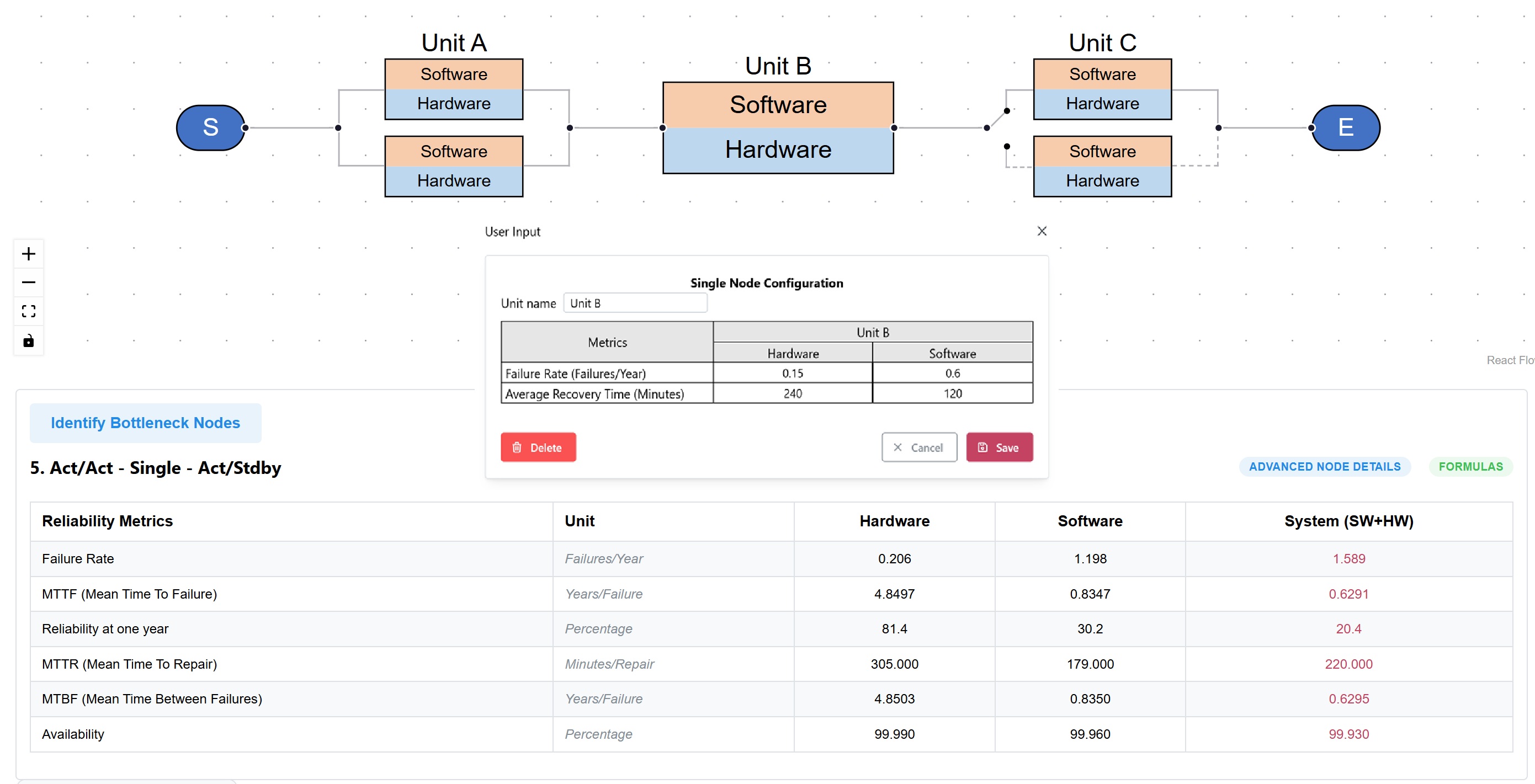
Model the integrated software-hardware system using iGRED.
Review system reliability metrics
Automatically compute key metrics: failure rate, MTTF, MTTR, reliability, availability, and MTBF.
Identify reliability bottlenecks
Highlight components that most limit system performance and availability using advanced node details.
How FUSION Works
From Data to System-Level Insight
Key Insight
FUSION integrates development and operational data to give teams early visibility into system risk, enabling informed trade-offs before deployment.
System-Level Capabilities / Differentiators
FUSION is validated against real-world operational datasets from aerospace, defense, and telecom domains.
Explore Reliability Engineering Concepts
Learn how reliability engineering, availability analysis, and integrated software-hardware reliability support modern systems.
Reliability Engineering FAQ →