Originally developed by Dr. Amrit L. Goel and Dr. Kazuhira Okumoto, the model provides a mathematical framework for describing and predicting the discovery of software defects during testing.
Since its introduction, the model has been widely cited in research literature, incorporated into software reliability engineering methodologies, and applied across numerous software development environments.
The Goel–Okumoto model remains one of the foundational techniques used for software reliability assessment, reliability growth analysis, and defect prediction.
Historical Note
The Goel–Okumoto Software Reliability Model was introduced by Dr. Amrit L. Goel and Dr. Kazuhira Okumoto and has become one of the most widely recognized models in software reliability engineering.
How Many Defects Remain?
Software testing discovers defects over time. One of the most important questions faced by software organizations is:
How many defects remain undiscovered?
Unfortunately, undiscovered defects cannot be observed directly. Organizations therefore require analytical methods capable of estimating:
- Total expected defects
- Remaining defects
- Reliability growth
- Future defect discovery behavior
- Release readiness
The Goel–Okumoto model was developed to address this challenge.
Non-Homogeneous Poisson Process
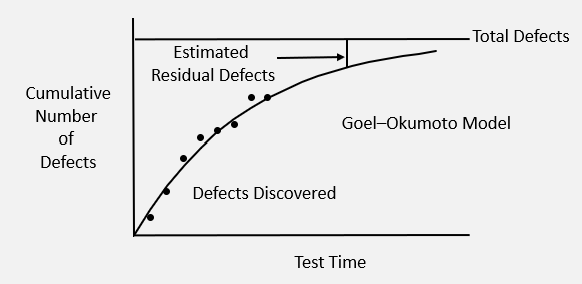
The model assumes that software failures discovered during testing follow a Non-Homogeneous Poisson Process (NHPP). The cumulative number of defects discovered over time is represented by:
As testing progresses
- Defects are discovered
- Fewer defects remain
- Cumulative discoveries approach the total defect estimate a
Observed behavior
Defect discoveries increase rapidly during early testing and gradually level off as fewer defects remain. This behavior closely matches many real-world software testing environments.
Understanding the Testing Process
The Goel–Okumoto model captures the reliability growth process mathematically and provides visibility into future testing outcomes.
As testing progresses
- More defects are discovered and removed.
- The number of remaining defects decreases.
- Failure intensity declines.
- Software reliability improves.
Organizations can estimate
- Remaining defects
- Future defect discoveries
- Reliability improvement
- Testing sufficiency
Failure Intensity
The corresponding failure intensity function is:
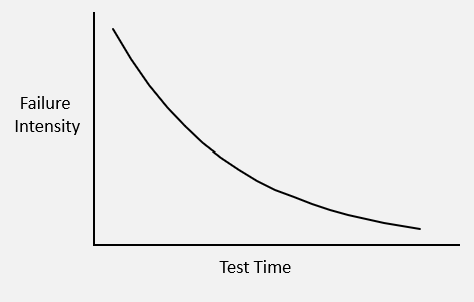
The declining failure intensity reflects reliability growth and maturity in the software system.
Why the Model Became Influential
- Is mathematically rigorous
- Is relatively simple to implement
- Requires only defect discovery data
- Produces interpretable parameters
- Supports practical engineering decisions
The model provides actionable insights into software quality conditions rather than simply reporting historical defect counts.
Applications
- Reliability growth analysis
- Defect prediction
- Residual defect estimation
- Release readiness assessment
- Testing management
- Reliability forecasting
It has influenced both academic research and industrial software quality practices for decades.
From Foundational Model to Reliability Intelligence
Many modern software quality analytics techniques trace their origins to software reliability growth models. At Sakura Software Solutions, the Goel–Okumoto model serves as the starting point for a broader evolution in predictive analytics for software quality and reliability.
- Residual defect prediction
- Open defect forecasting
- Release readiness assessment
- Operational reliability prediction
- Software and hardware reliability integration
- Operational risk assessment
- AI-assisted predictive governance
- Defect arrival forecasting
- Defect closure forecasting
The STAR™, FUSION™, and ARC™ technologies build upon principles originally established through software reliability engineering research.
A Foundational Tool for Predictive Quality
The Goel–Okumoto model helped establish software reliability engineering as a practical engineering discipline.
Today, organizations continue to face the same fundamental challenge: How can future software quality and reliability conditions be predicted before deployment?
While software development practices have evolved significantly, predictive analytics remains essential for managing quality, reliability, availability, and operational risk.
The Goel–Okumoto model remains one of the foundational tools that helped make predictive software quality management possible.
About the Authors
Dr. Amrit L. Goel and Dr. Kazuhira Okumoto introduced the Goel–Okumoto model to provide a practical and mathematically sound approach for software reliability growth analysis.
The model continues to be referenced in research, education, and industry applications worldwide and remains one of the most recognized contributions to the field of software reliability engineering.