Traditional software quality analytics focus primarily on development and testing activities.
Questions such as:
- How many defects remain?
- How many defects will be discovered?
- How many defects will remain open?
are important for release decisions.
However, software quality management does not end at release.
Organizations must also understand:
What will happen after deployment?
Operational Reliability Modeling extends predictive analytics beyond development and into the operational environment.
This capability forms a foundational component of the FUSION™ framework.
01 / Method
Why Operational Reliability Matters
Software systems continue to evolve after release.
Even after testing is completed, organizations must manage:
- Customer-reported defects
- Service disruptions
- Availability risks
- Operational failures
- Maintenance activities
Understanding future operational behavior is essential for managing reliability and business risk.
Traditional software quality metrics provide limited visibility into post-release operational conditions.
Operational Reliability Modeling addresses this gap.
02 / Method
Development Quality and Operational Reliability
Software defects discovered during testing represent only part of the quality picture.
After deployment, organizations encounter:
- Customer-reported defects
- Operational incidents
- Service interruptions
- Reliability degradation
Understanding the relationship between development quality and operational performance is essential for predicting future operational behavior.
A key objective of FUSION is to establish a quantitative relationship between software quality indicators and operational reliability outcomes.
03 / Method
Customer Defects as an Operational Indicator
Customer-reported defects are among the most important indicators of post-release software quality.
Customer defects represent:
- Residual quality issues
- Real-world usage conditions
- Operational exposure
- User experience impacts
Because customer defects occur after deployment, they provide valuable insights into future operational reliability.
FUSION uses customer defect behavior to bridge software quality analytics and operational reliability analytics.
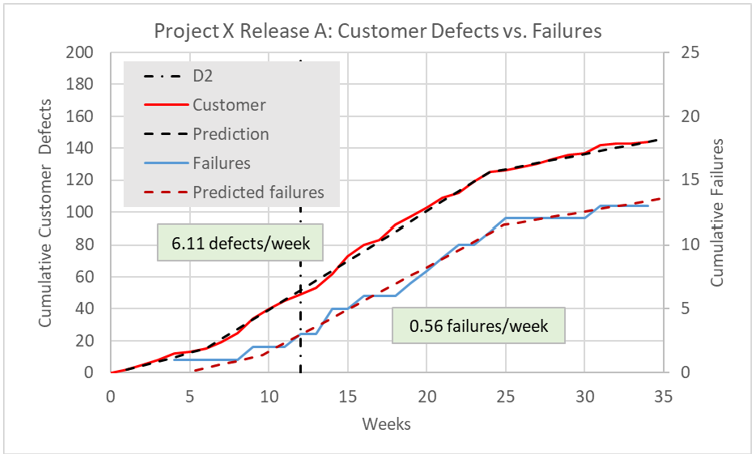
FUSION establishes a quantitative relationship between customer-reported defects and operational failures. By modeling this relationship, customer defect information can be transformed into operational failure-rate predictions and reliability metrics.
04 / Method
Customer Defect Prediction
Predicting Post-Release Quality Behavior
A key component of Operational Reliability Modeling is forecasting future customer defect behavior.
FUSION employs the Linear Prediction Model (LPM) to estimate future customer defect trends using observed operational defect data.
The model provides visibility into:
- Future customer defect arrivals
- Post-release quality trends
- Operational quality risk
- Maintenance planning requirements
Forecasting customer defect behavior provides an early indication of future operational conditions.
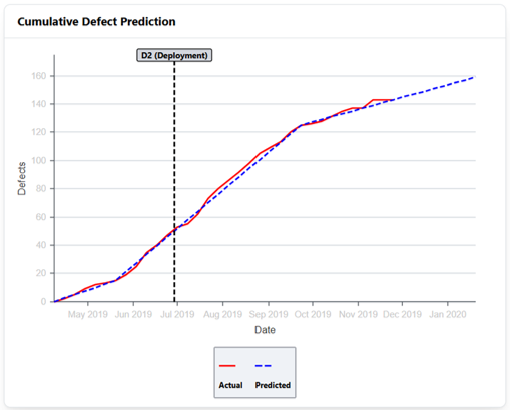
The Linear Prediction Model (LPM) forecasts future customer defect behavior using observed post-release defect data. These forecasts provide visibility into future quality trends and operational support requirements.
05 / Method
Operational Failure Prediction
Predicting Future Software Failures
Customer defects alone do not fully characterize operational reliability.
Organizations must also understand:
How many operational failures are likely to occur?
Operational failures directly affect:
- Service availability
- User experience
- Operational continuity
- Business performance
FUSION employs the Failure Prediction Model (FPM) to forecast future operational failure behavior.
The model estimates future software failure activity based on observed operational data and customer defect information.
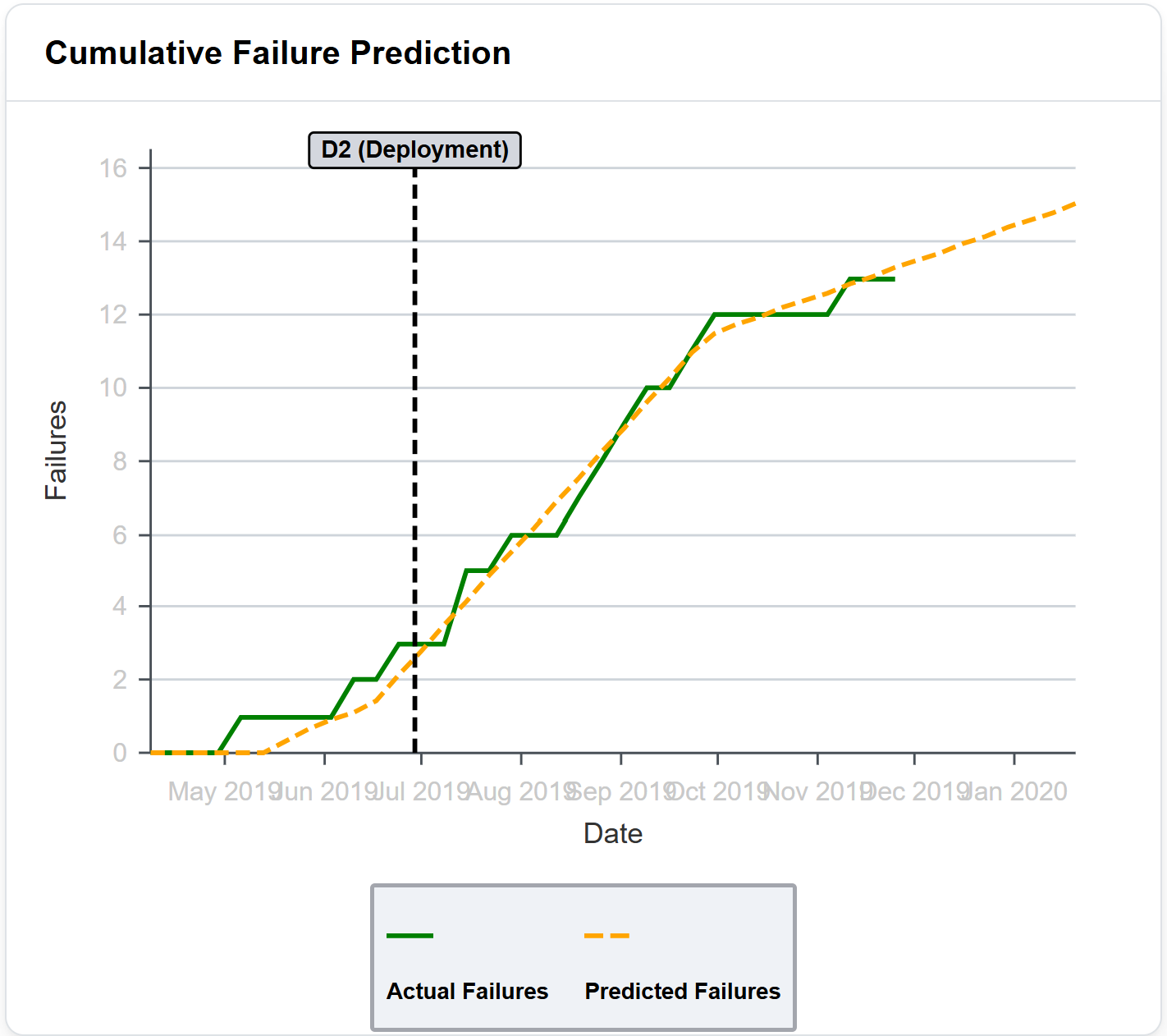
The Failure Prediction Model (FPM) forecasts operational failures and estimates future software failure behavior in deployed environments.
06 / Method
From Customer Defects to Operational Failures
One of the key innovations introduced by FUSION is the ability to transform customer defect information into operational failure predictions.
Conceptually:
FPM establishes a quantitative mapping between customer-reported defects and operational failures, enabling software quality information to be transformed into predictions of operational reliability. This transformation enables organizations to estimate operational reliability using information that is often more readily available than direct failure measurements.
The approach provides a practical mechanism for connecting software quality indicators with operational reliability outcomes.
07 / Method
Constant Operational Failure Rate
A Bridge Between Software and Hardware Reliability
A key observation that emerged during the development of FUSION was that software failure behavior often stabilizes during operational use.
Analysis of customer defect and operational failure data showed that software failure rates frequently approach an approximately constant level after deployment.
Unlike software testing environments, where defect discovery behavior changes continuously, operational environments often exhibit more stable failure behavior.
Conceptually:
This observation is important because hardware reliability models are also commonly based on constant failure-rate assumptions.
As a result, software and hardware reliability can be represented within a common analytical framework, simplifying system-level reliability and availability modeling.
The ability to model software operational behavior with a constant failure rate is a key foundation for software-hardware reliability integration within the FUSION framework.
08 / Method
Operational Reliability Metrics
Operational Reliability Modeling supports estimation of:
- Failure Rate (λ)
- Reliability R(t)
- Mean Time To Failure (MTTF)
- Mean Time Between Failures (MTBF)
- Availability
These metrics are derived from the predicted operational failure behavior generated by FPM.
These metrics provide a common framework for evaluating software operational performance and reliability.
Because these measures are widely used throughout reliability engineering, they also provide a natural bridge between software reliability and hardware reliability.
09 / Method
Beyond Development Analytics
Traditional software quality analytics answer questions such as:
Is the software ready to release?
Operational Reliability Modeling addresses a broader question:
What level of reliability can be expected after release?
This shift expands predictive analytics from software delivery management to operational risk management.
Organizations gain visibility into future operational conditions before failures affect users and services.
10 / Method
Foundation for Software-Hardware Reliability Integration
Operational Reliability Modeling establishes the foundation for one of the most important innovations of FUSION:
Integrated software and hardware reliability analysis.
Once software operational failure behavior is estimated, software reliability metrics can be combined with hardware reliability models to predict system-level reliability and availability.
This integration provides a unified framework for evaluating modern software-intensive systems.
11 / Method
Supporting Operational Risk Management
Operational Reliability Modeling helps organizations:
- Anticipate operational failures
- Assess reliability risk
- Plan maintenance activities
- Improve service continuity
- Support availability management
The result is a proactive approach to reliability management that extends beyond software delivery and into operational performance.
12 / Method
Looking Ahead
Operational Reliability Modeling extends predictive analytics beyond software testing and release readiness into operational environments.
The next Methods page introduces Software-Hardware Reliability Integration, which combines software operational reliability with hardware reliability models to predict system-level reliability, availability, and operational risk.
Together, these capabilities form the foundation of the FUSION™ framework for integrated reliability engineering.