Software quality is determined not only by how many defects are discovered, but also by how effectively those defects are resolved.
While defect arrivals represent incoming work, defect closures represent completed work. Organizations must understand both perspectives to accurately assess software readiness and delivery risk.
One of the most important questions during software development is:
How many defects will be resolved before release?
The Closure Curve Prediction Model (CCPM) was developed to forecast future defect closure behavior and provide visibility into software delivery performance prior to release.
Unlike traditional Software Reliability Growth Models (SRGMs), which primarily focus on defect discovery and reliability growth, CCPM focuses on the defect resolution process and its impact on software quality and release readiness.
01 / Method
Why Defect Closure Forecasting Matters
Defect arrivals indicate software quality conditions.
Defect closures indicate the organization's ability to address those conditions.
Understanding future defect closures helps organizations:
- Evaluate development effectiveness
- Assess resource sufficiency
- Estimate future workloads
- Predict open defects
- Support release planning
- Identify schedule risks
- Improve delivery readiness
Without closure forecasting, organizations may understand quality problems but have limited visibility into their ability to resolve them before release.
02 / Method
Defect Closure Curves
Defect closures typically follow recognizable patterns during software testing and development.
Closure behavior is influenced by:
- Development staffing levels
- Defect complexity
- Verification effort
- Testing effectiveness
- Project priorities
- Schedule pressure
Understanding closure trends is essential for predicting future software readiness.
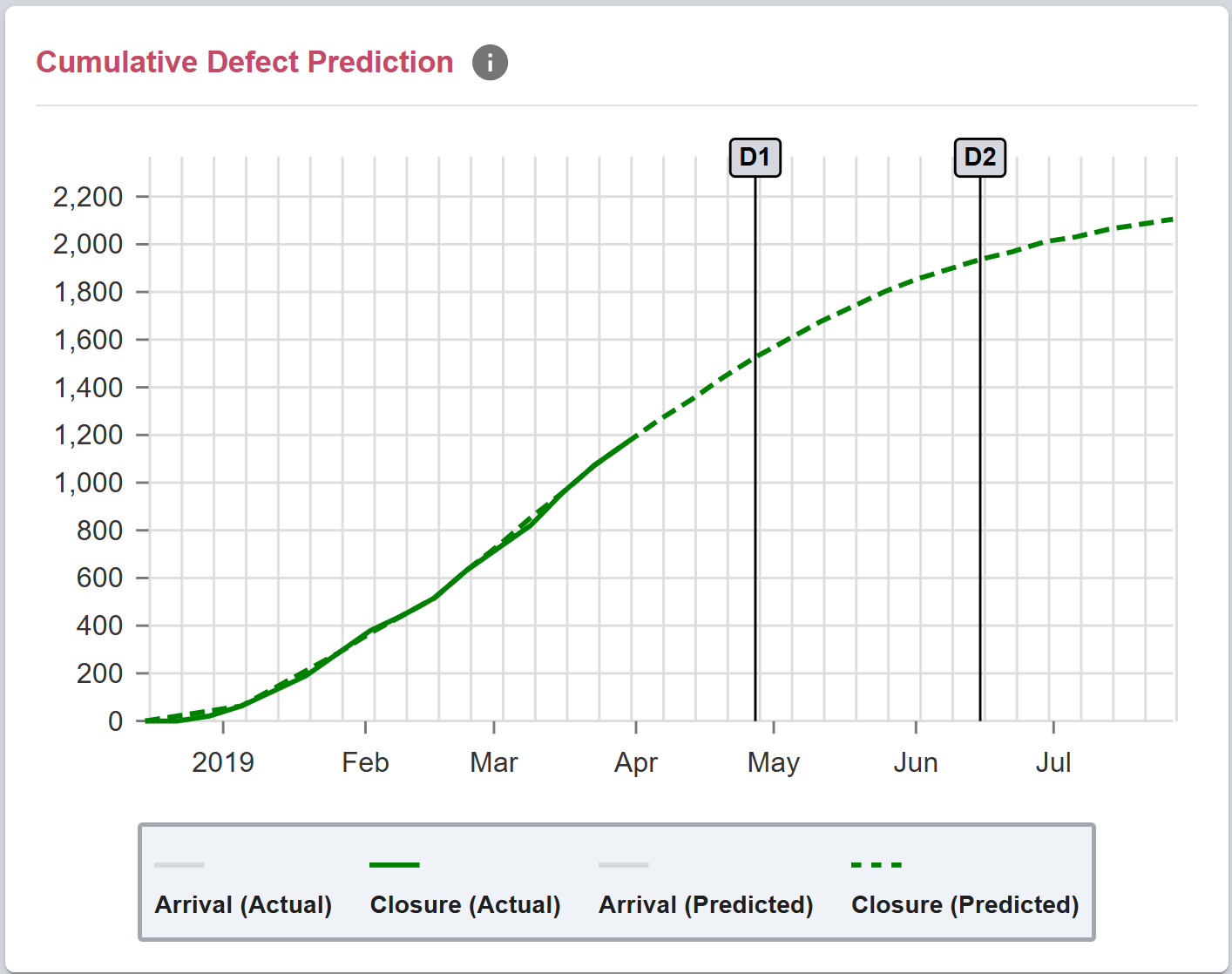
CCPM uses historical defect-closure data together with forecasted defect arrivals to predict future defect-resolution behavior. Closure forecasts provide visibility into software delivery performance and future release-readiness conditions.
03 / Method
The Closure Curve Prediction Model (CCPM)
Forecasting Future Defect Resolution Behavior
The Closure Curve Prediction Model was developed to forecast future closure activity based on observed project behavior.
Unlike traditional reliability growth models that focus primarily on defect arrivals, CCPM focuses on the resolution side of the software quality process.
The model estimates future closure trajectories and helps organizations determine whether defect-resolution capacity is sufficient to support planned releases.
CCPM provides a predictive view of software delivery performance rather than merely reporting historical closure activity.
04 / Method
Relationship Between Arrivals and Closures
Defect arrivals and defect closures are closely related.
In most software projects:
As defects are discovered, development teams analyze, correct, verify, and close them.
This creates a predictable relationship between arrival behavior and closure behavior.
Understanding this relationship is the foundation of CCPM.
05 / Method
Closure Curve Prediction Logic
From Arrival Forecasts to Closure Forecasts
One of the key innovations of CCPM is its ability to derive closure forecasts directly from arrival forecasts.
The forecasted closure curve is generated by shifting the forecasted arrival curve to account for the average delay between defect discovery and closure.
This delay represents the time required for:
- Defect analysis
- Assignment
- Software correction
- Retesting
- Verification
- Final closure
Because defect resolution typically follows defect discovery with a predictable delay, future closure behavior can be estimated using forecasted arrival information.
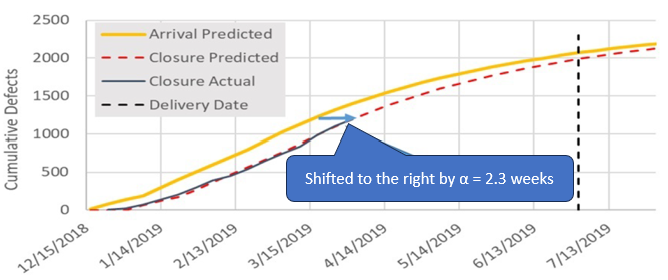
CCPM derives closure forecasts by shifting the forecasted arrival curve to account for the average delay between defect discovery and closure. The closure-shift parameter captures the natural lag between defect arrivals and defect resolutions.
06 / Method
Closure Shift Parameter
Modeling Resolution Delay
The relationship between arrivals and closures is represented through a closure-shift parameter, denoted by α.
The closure-shift parameter represents the average delay between:
This delay varies across projects and may be influenced by:
- Resource availability
- Defect complexity
- Development efficiency
- Verification requirements
- Project priorities
By estimating the closure-shift parameter, CCPM converts forecasted arrival curves into realistic closure forecasts.
The closure-shift parameter provides a simple yet effective mechanism for modeling software delivery performance.
07 / Method
Supporting Open Defect Prediction
Arrival forecasts alone do not determine software readiness.
Organizations must also understand:
How many defects will remain unresolved?
Open defects are determined by the difference between arrivals and closures.
Conceptually:
Therefore, accurate closure forecasts are essential for predicting future open-defect conditions.
CCPM provides one of the key analytical inputs required for open-defect prediction.
08 / Method
Supporting Release Readiness
Defect closure forecasts provide visibility into an organization's ability to resolve defects before release.
Organizations can use CCPM to evaluate:
- Resolution capacity
- Resource sufficiency
- Schedule feasibility
- Open-defect risk
- Release readiness
Earlier visibility enables teams to identify potential delivery risks and take corrective actions before release commitments are affected.
09 / Method
Beyond Classical Reliability Growth Models
Traditional Software Reliability Growth Models focus primarily on:
CCPM extends this perspective by introducing predictive analysis of:
This broader view provides organizations with actionable information that directly supports software delivery decisions.
10 / Method
From CCPM to Open Defect Prediction
Forecasting defect arrivals and defect closures provides a more complete view of software quality conditions.
However, management decisions often depend upon a third metric:
How many defects will remain open?
Open defects represent the balance between incoming defects and completed work.
The next Methods page introduces Open Defect Prediction, which combines MPM and CCPM forecasts to estimate future open-defect conditions and support release-readiness assessments.
11 / Method
Supporting Predictive Software Quality Analytics
The Closure Curve Prediction Model represents a significant advancement in predictive analytics for software quality.
By forecasting future defect resolution behavior, organizations can:
- Improve planning accuracy
- Strengthen quality governance
- Anticipate delivery risks
- Support release-readiness assessments
- Enable data-driven decision-making
Together with MPM, CCPM forms one of the foundational analytical components of the STAR™ Predictive Quality Intelligence framework.
12 / Method
Looking Ahead
MPM forecasts future defect arrivals.
CCPM forecasts future defect closures.
Together, these models provide the foundation for:
- Open Defect Prediction
- Residual Defect Estimation
- Release Readiness Analytics
- Corrective Action Evaluation
- STAR™ Predictive Quality Intelligence
and represent a significant evolution beyond traditional software reliability growth models.