01 / Integrated reliability
Why Integration Matters
Historically, software and hardware reliability have often been analyzed separately.
Software teams focus on:
- Defects
- Failures
- Software quality metrics
Hardware teams focus on:
- Failure rates
- Reliability
- Availability
However, users experience the behavior of the complete system.
They do not distinguish between software failures and hardware failures.
They experience:
- System Failures
Therefore, software and hardware reliability must be analyzed together.
02 / Integrated reliability
The Challenge of Integration
Traditional software reliability models and hardware reliability models have historically used different assumptions.
Software reliability analysis often focuses on:
- Defect discovery
- Reliability growth
- Failure prediction
Hardware reliability analysis typically focuses on:
- Failure rates
- Reliability functions
- Availability metrics
Because these perspectives differ, integration has often been difficult.
FUSION addresses this challenge by transforming software operational behavior into reliability metrics that are directly compatible with hardware reliability models.
03 / Integrated reliability
Software Reliability Representation
The Operational Reliability Modeling methodology established that software failure behavior often stabilizes after deployment.
This allows software reliability to be represented using standard reliability engineering metrics such as:
- Failure Rate (λsw)
- Reliability Rsw(t)
- Mean Time To Failure (MTTF)
- Mean Time Between Failures (MTBF)
Conceptually:
Customer Defects
        ↓
Operational Failures
        ↓
Software Failure Rate λsw
Once software behavior is represented in this form, it becomes compatible with traditional hardware reliability models.
04 / Integrated reliability
Hardware Reliability Representation
Hardware reliability is typically represented using:
- Failure Rate (λhw)
- Reliability Rhw(t)
- Mean Time To Failure (MTTF)
- Mean Time Between Failures (MTBF)
For many electronic and communication systems, hardware failure behavior can be approximated using constant failure-rate assumptions.
Conceptually:
Hardware Components
        ↓
Failure Rate λhw
These measures provide the basis for system-level reliability analysis.
05 / Integrated reliability
A Common Reliability Framework
One of the key innovations of FUSION is the ability to represent both software and hardware behavior using a common reliability framework.
Conceptually:
Software Failure Rate λsw
            +
Hardware Failure Rate λhw
            ↓
Integrated Reliability Model
This transformation enables software and hardware components to be analyzed together within a unified system model.
06 / Integrated reliability
Intelligent Graphical Reliability Modeling
To simplify software–hardware reliability integration, FUSION provides the Intelligent Graphical Editor (iGRED).
iGRED enables engineers to construct Reliability Block Diagrams (RBDs) using an intuitive graphical interface rather than performing reliability calculations manually.
The platform supports preconfigured templates for common architectures including:
- Single-node systems
- Series systems
- Parallel systems
- Active-active redundancy
- Active-standby redundancy
- k-out-of-n configurations
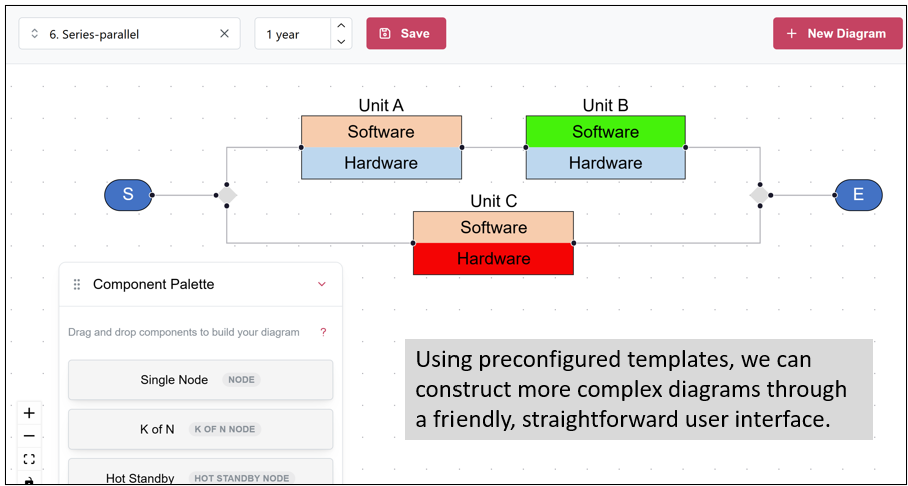
By simplifying model creation, iGRED allows engineers to evaluate complex architectures without requiring extensive reliability engineering expertise.
07 / Integrated reliability
Reliability Block Diagram Integration
Reliability Block Diagrams provide a powerful method for representing system architectures.
Each system component may contain:
- Hardware reliability characteristics
- Software reliability characteristics
- Repair information
- Availability parameters
By integrating software and hardware information within a single RBD, FUSION supports comprehensive system-level analysis.
The resulting model provides visibility into how component behavior affects overall system performance.
08 / Integrated reliability
Automated Reliability Analysis
Once a system model has been created, FUSION automatically computes software, hardware, and system-level reliability and availability metrics in real time.
Engineers can immediately evaluate:
- Failure rates
- Reliability
- MTTF
- MTTR
- MTBF
- Availability
for both individual components and the overall system.
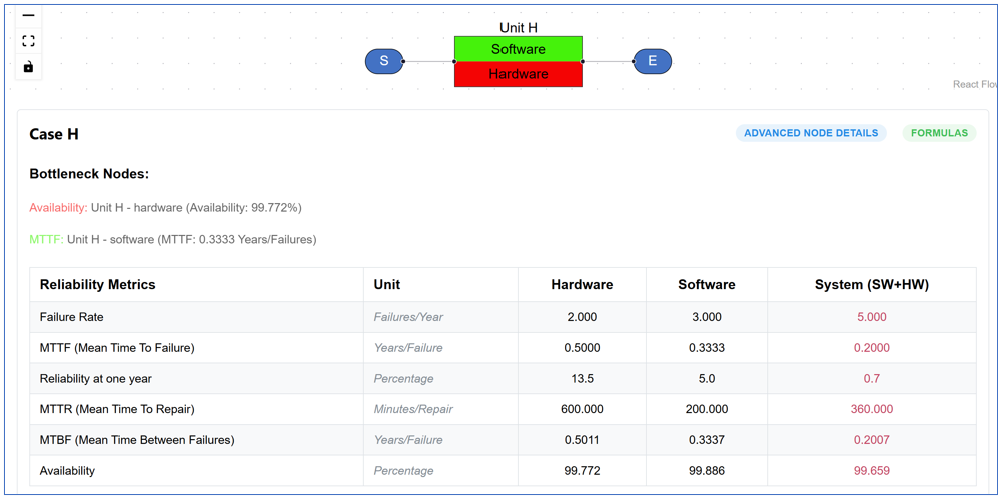
Automated calculations eliminate the need for manual reliability analysis and provide immediate feedback as system architectures are modified.
09 / Integrated reliability
Example Integrated Results
The example shown in Figure 2 demonstrates how software and hardware reliability information is combined to generate system-level metrics.
Example outputs include:
- System Failure Rate: 5 failures/year
- System MTTF: 0.20 years
- System MTTR: 360 minutes
- System MTBF: 0.2007 years
- System Availability: 99.659%
These metrics are automatically updated as system architectures and component characteristics are modified.
10 / Integrated reliability
Unified Reliability Metrics
Once software and hardware reliability are represented within a common framework, FUSION computes system-level metrics including:
- System Failure Rate (λsys)
- System Reliability Rsys(t)
- Mean Time To Failure (MTTF)
- Mean Time To Repair (MTTR)
- Mean Time Between Failures (MTBF)
- Availability
These metrics are calculated at both the component and overall system levels.
This capability enables engineers to understand how individual software and hardware elements contribute to overall system behavior.
11 / Integrated reliability
Reliability Bottleneck Identification
Complex systems often contain components that disproportionately influence overall reliability and availability.
FUSION automatically identifies these bottlenecks and highlights components that have the greatest impact on system performance.
This capability helps engineers:
- Prioritize reliability improvements
- Evaluate redundancy strategies
- Optimize system architectures
- Improve availability
- Reduce operational risk
By focusing attention on the most influential components, organizations can improve reliability more efficiently.
12 / Integrated reliability
Supporting Modern Software-Intensive Systems
Software–Hardware Reliability Integration is particularly valuable for:
- Open RAN networks
- Cloud-native systems
- Edge computing platforms
- Aerospace systems
- Medical systems
- Industrial automation
- Semiconductor manufacturing systems
- Autonomous transportation systems
These environments require simultaneous consideration of software and hardware behavior.
13 / Integrated reliability
Beyond Traditional Reliability Analysis
Traditional reliability analysis often evaluates software and hardware separately.
FUSION extends this perspective by providing a unified framework for:
Software Reliability
            +
Hardware Reliability
            ↓
System Reliability
            ↓
System Availability
            ↓
Operational Risk
This integrated approach provides a more realistic representation of modern software-intensive systems.
14 / Integrated reliability
Foundation for Availability Modeling
Software–Hardware Reliability Integration provides the foundation for system availability analysis.
Availability depends not only on:
- Software reliability
- Hardware reliability
but also on:
- Repair processes
- Redundancy architectures
- Operational configurations
Once software and hardware reliability are integrated, availability can be estimated for complex operational systems.
15 / Integrated reliability
Supporting Engineering Decision-Making
Software–Hardware Reliability Integration helps organizations:
- Assess system reliability
- Evaluate architectural alternatives
- Analyze redundancy strategies
- Improve availability
- Reduce operational risk
The result is a comprehensive approach to reliability engineering and operational planning.
16 / Integrated reliability
Looking Ahead
Software–Hardware Reliability Integration transforms software quality information into system-level reliability intelligence.
The next Methods page introduces Availability Modeling, which uses integrated software and hardware reliability information to estimate system uptime, service continuity, and operational resilience.
Together, these capabilities form the foundation of the FUSION™ framework for integrated reliability engineering.