As testing progresses and defects are identified and removed, software reliability improves. SRGMs provide a quantitative framework for understanding reliability growth and estimating future software quality conditions.
Over the past several decades, SRGMs have become foundational analytical tools in software reliability engineering and have been widely used in both research and industry.
The Goel–Okumoto model is one of the most widely recognized and influential Software Reliability Growth Models and helped establish the field of software reliability growth analysis.
Historical Note
The Goel–Okumoto model was introduced by Dr. Amrit L. Goel and Dr. Kazuhira Okumoto and became one of the most widely recognized Software Reliability Growth Models used in software reliability engineering research and practice.
Why Reliability Growth Models Were Developed
Understanding Software Quality Before Release
Software organizations face a common challenge:
How can future software quality be predicted before deployment?
Testing provides information about defects that have already been discovered. However, decision makers also need to understand:
- How many defects remain?
- How quickly are defects being discovered?
- Is reliability improving?
- Is testing sufficient?
- Is the software ready for release?
Software Reliability Growth Models were developed to answer these questions.
What Is Reliability Growth?
Reliability growth occurs when software failures are identified and corrected during testing. As defects are removed:
- Failure intensity decreases.
- Reliability improves.
- Fewer defects remain.
- Software quality increases.
The objective of an SRGM is to describe this process and estimate future behavior mathematically.
Representative Software Reliability Growth Models
Software reliability researchers have proposed numerous models over the years.
Although these models differ mathematically, they share a common goal: predicting future software quality and reliability conditions.
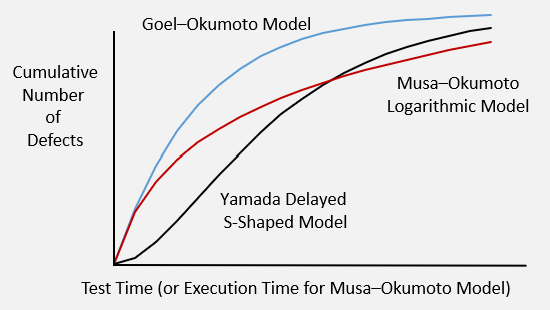
Goel–Okumoto Model
The Goel–Okumoto model assumes exponential reliability growth and is one of the most widely recognized Software Reliability Growth Models. Characteristics include:
- Non-Homogeneous Poisson Process (NHPP)
- Exponential reliability growth
- Residual defect estimation
- Practical engineering applicability
The model remains one of the most influential SRGMs in software reliability engineering.
Explore the Goel–Okumoto modelMusa–Okumoto Logarithmic Model
The Musa–Okumoto model extends reliability growth concepts using execution time and logarithmic failure behavior. Characteristics include:
- Execution-time based modeling
- Failure intensity analysis
- Reliability assessment
- Operational software measurement
The model is particularly useful when software execution behavior is more meaningful than calendar time.
Yamada Delayed S-Shaped Model
The Yamada model introduces a delayed learning effect into the defect discovery process. Characteristics include:
- S-shaped reliability growth
- Learning-oriented testing behavior
- Delayed defect discovery acceleration
- Improved representation of certain testing environments
The model is useful when testing effectiveness improves as testers gain experience with the software.
Common Characteristics of SRGMs
Most Software Reliability Growth Models attempt to estimate:
- Total defects
- Remaining defects
- Reliability growth
- Failure intensity
- Future defect discoveries
Many models assume that defect discoveries follow a Non-Homogeneous Poisson Process (NHPP) and use observed data on defect discovery to estimate future software quality conditions.
Strengths of Classical SRGMs
Software Reliability Growth Models provide several important benefits. They help organizations:
- Estimate residual defects
- Assess reliability growth
- Forecast defect discovery trends
- Evaluate testing sufficiency
- Support release decisions
For many years, SRGMs represented the primary analytical framework for predictive software quality assessment.
Limitations of Traditional SRGMs
Although SRGMs remain valuable, modern software environments present new challenges. Traditional models focus primarily on defect arrivals, failure discovery patterns, and reliability growth.
However, modern software organizations also require visibility into:
- Defect closure behavior
- Open defect trends
- Resource sufficiency
- Release readiness
- Operational risk
These questions extend beyond the scope of most classical reliability growth models.
Evolution Beyond Classical SRGMs
From Reliability Growth to Quality Governance
Traditional SRGMs focus primarily on defects discovered and reliability growth. Modern software organizations require broader visibility.
Classical SRGMs: Defects Discovered → Reliability Growth
Modern visibility: Defect Arrivals · Defect Closures · Open Defects · Residual Defects · Release Readiness · Operational Risk
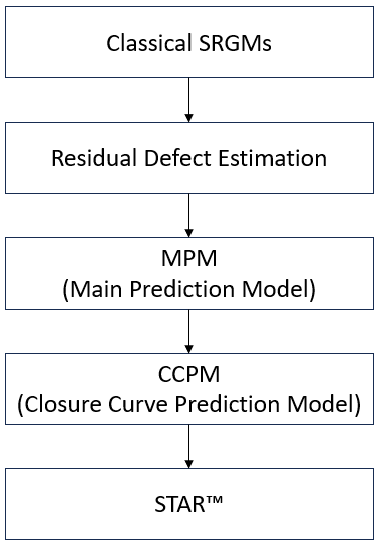
This broader perspective led to the development of advanced predictive quality analytics approaches.
From SRGMs to STAR™
The STAR™ framework extends traditional reliability growth concepts by introducing:
- Defect Arrival Forecasting
- Defect Closure Forecasting
- Open Defect Prediction
- Residual Defect Estimation
- Release Readiness Assessment
- Corrective Action Evaluation
Unlike traditional SRGMs, which focus primarily on defect discovery and reliability growth, STAR evaluates defect arrivals, defect closures, open defects, residual defects, release readiness, and corrective actions, providing a more comprehensive framework for software quality governance.
Continuing Relevance of SRGMs
Despite advances in predictive analytics, Software Reliability Growth Models remain an important foundation of software reliability engineering. Their core principles continue to influence:
- Reliability assessment
- Quality prediction
- Risk analysis
- Release management
- Predictive analytics
Modern approaches such as STAR™, FUSION™, and ARC™ build upon these foundational concepts while extending them to address increasingly complex software development and operational environments.
Historical Perspective
Software Reliability Growth Models played a critical role in establishing software reliability engineering as a practical engineering discipline.
The Goel–Okumoto model, Musa–Okumoto model, Yamada model, and many other SRGMs provided the mathematical foundation for predictive software quality analysis and reliability assessment.
Today, organizations continue to face the same fundamental challenge:
How can future software quality and reliability conditions be predicted before deployment?
Modern predictive analytics extends these principles while incorporating broader perspectives on quality governance, operational risk, and decision support.
Looking Ahead
Software Reliability Growth Models established the foundation for predictive software quality analytics.
The next step in this evolution is understanding how defect discovery behavior can be modeled more effectively in modern software development environments.
The following Methods pages introduce:
- Defect Arrival Forecasting (MPM)
- Defect Closure Forecasting (CCPM)
- Open Defect Prediction
- Release Readiness Analytics
These extend classical reliability growth concepts into a comprehensive framework for software quality governance.